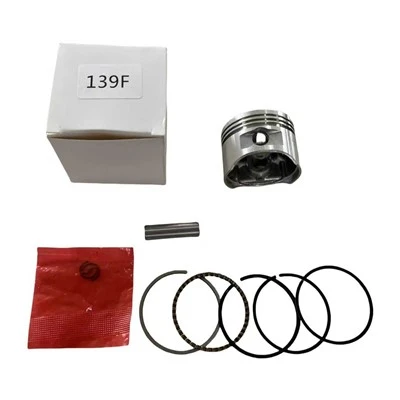

Hey there! As a supplier of 768 parts, I often get asked about the fatigue strength of these components. So, I thought I'd take a moment to break it down for you.
First off, let's talk about what fatigue strength actually means. Fatigue strength is the maximum stress that a material can withstand for a given number of cycles without failing. When a part is subjected to repeated loading and unloading, it can develop tiny cracks over time. These cracks can grow and eventually lead to failure. Fatigue strength is all about understanding how much stress a part can handle before these cracks become a problem.
Now, when it comes to the 768 parts, we're dealing with a variety of materials and designs. Different 768 parts are used in different applications, and each one has its own unique set of requirements. Some 768 parts might be used in high - stress environments, like in heavy - duty machinery, while others might be used in more light - duty applications.
Let's start by looking at the materials. The 768 parts are typically made from high - quality metals or polymers. Metals like steel and aluminum are known for their good fatigue resistance. Steel, for example, has a crystalline structure that can resist the propagation of cracks. When a steel 768 part is under cyclic loading, the dislocations in the crystal structure can move and redistribute the stress, which helps prevent the formation and growth of cracks.
Aluminum is also a popular choice. It's lightweight, which is great for applications where weight is a concern, like in some portable equipment. Aluminum has a relatively high strength - to - weight ratio, and its fatigue properties can be improved through proper heat treatment and alloying. For instance, adding small amounts of copper, magnesium, or zinc to aluminum can enhance its fatigue strength.
Polymers, on the other hand, have different fatigue characteristics. They're often used in applications where flexibility and corrosion resistance are important. Polymers can deform more easily than metals, which means they can absorb some of the energy from cyclic loading. However, they can also be more prone to creep and stress relaxation, which can affect their long - term fatigue performance.
The design of the 768 parts also plays a crucial role in their fatigue strength. Parts with smooth surfaces and rounded edges are less likely to develop stress concentrations. Stress concentrations are areas where the stress is much higher than the average stress in the part. Sharp corners or notches can act as stress raisers, making it easier for cracks to initiate. So, when we design our 768 parts, we pay close attention to the geometry to minimize stress concentrations.
Another factor is the manufacturing process. How the 768 parts are made can have a big impact on their fatigue strength. For example, parts that are machined have a different surface finish compared to parts that are cast or forged. A rough surface finish can act as a stress raiser, increasing the likelihood of crack initiation. That's why we use advanced manufacturing techniques to ensure a smooth and consistent surface finish on our 768 parts.
In addition, the heat treatment process can significantly improve the fatigue strength of metal parts. Heat treatment can change the microstructure of the metal, making it more resistant to crack propagation. For example, quenching and tempering can increase the hardness and toughness of steel, which in turn improves its fatigue properties.


Now, let's talk about some real - world applications of the 768 parts. One common application is in Sprayer tank cap. These caps are subjected to repeated opening and closing, as well as pressure changes inside the tank. The fatigue strength of the 768 parts used in the sprayer tank cap is crucial to ensure that it doesn't fail over time. If the cap fails, it can lead to leaks, which can be a safety hazard and also cause damage to the equipment.
In the automotive industry, 768 parts might be used in engine components or suspension systems. These parts are under constant cyclic loading due to the movement of the vehicle. A failure in these parts can have serious consequences, so high fatigue strength is essential.
So, how do we test the fatigue strength of our 768 parts? We use a variety of testing methods. One common method is the fatigue testing machine. This machine applies a cyclic load to the part at a specific frequency and amplitude. The number of cycles the part can withstand before failure is recorded. We also use non - destructive testing techniques, like ultrasonic testing and X - ray inspection, to detect any internal cracks or defects in the parts.
Based on our extensive testing and experience, we can provide our customers with reliable information about the fatigue strength of our 768 parts. We know that different applications have different requirements, so we work closely with our customers to understand their needs and provide the right parts for the job.
If you're in the market for high - quality 768 parts with excellent fatigue strength, we'd love to hear from you. Whether you're in the agricultural, automotive, or any other industry that uses these parts, we can offer you the best solutions. Our team of experts is always ready to answer your questions and help you find the right parts for your specific application. So, don't hesitate to reach out and start a conversation about your procurement needs.
References
- "Materials Science and Engineering: An Introduction" by William D. Callister Jr. and David G. Rethwisch
- "Mechanical Behavior of Materials" by Norman E. Dowling